Cost of Building a Mobile App in Nigeria in 2027
What does a mobile app cost in Nigeria in 2027? See naira ranges for MVP, standard and complex builds, with timelines, feature costs and upkeep.
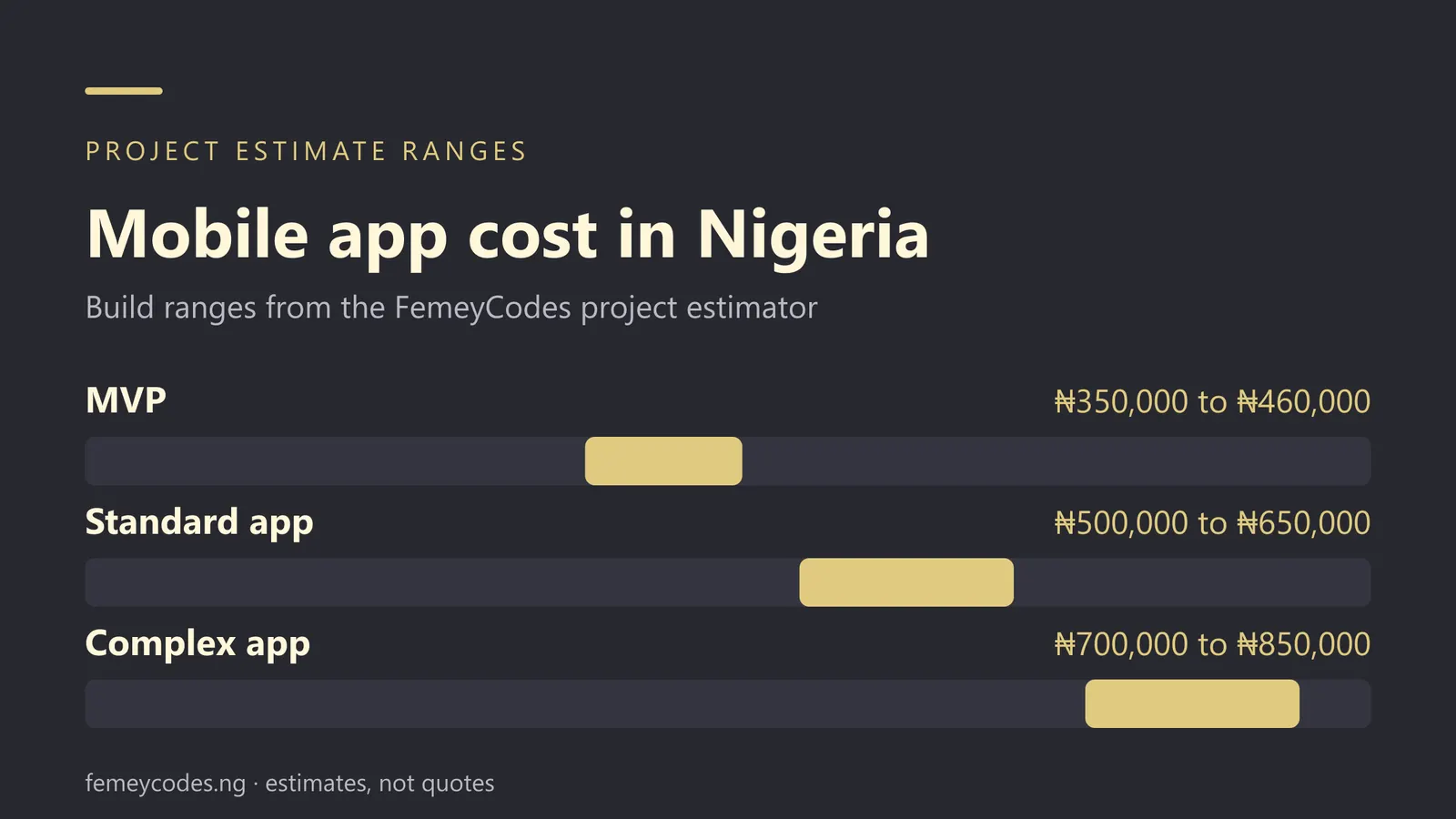
A lean MVP app in Nigeria costs about ₦350,000 to ₦460,000, a standard app with payments and push notifications runs ₦500,000 to ₦650,000, and a complex build with chat or offline sync sits around ₦700,000 to ₦850,000. Those figures come from our project estimator, where scope and complexity set the price.
Below is what each range buys, how your platform choice changes the bill, which features cost real money, and how to launch something people use instead of something nobody asked for.
App prices by scope
| Scope | Build estimate | Timeline | What it covers |
|---|---|---|---|
| MVP (starter) | ₦350,000 to ₦460,000 | 3 to 4 weeks | One core flow, login, one payment or one data source, basic admin |
| Standard app | ₦500,000 to ₦650,000 | 4 to 6 weeks | Roles, Paystack or Flutterwave checkout, push notifications, reports |
| Complex app | ₦700,000 to ₦850,000 | 6 to 8 weeks | Chat, offline sync, file processing, multiple integrations, hardening |
The estimator reaches those numbers with a base price for the project type, plus the features you tick, multiplied by the complexity level. Nothing is hidden in the range. If your scope sits between two rows, your quote will too.
Android, iOS or both
Android first is the usual call in Nigeria. One build reaches most of your customers, and Google Play charges a single $25 registration before you can publish. For a dispatch app, a clinic booking tool or a shop selling on Instagram, starting on Android gets you in front of users sooner for less money.
iOS matters when your customers are diaspora-facing or high-spend, because iPhone users tend to pay for apps more readily. Apple charges $99 a year for its developer programme, and its review process adds a few days before every release.
Cross-platform with Flutter or React Native is the middle path and the one we reach for most. You write the app once and ship to both stores, which costs far less than paying two teams to build and maintain the same feature twice. A few platform specific pieces, background services or heavy camera work, may still need native code, and that is worth asking about before you sign.
The features that move the price
Some features are line items in the estimator, with a price and a delivery estimate attached:
- Authentication and role management: about ₦10,000
- Payment integration with Paystack or Monnify: about ₦15,000
- Push notifications and realtime feeds: about ₦30,000
- File uploads and processing: about ₦40,000
- Security hardening and automated backups: about ₦15,000
The features that are not on that list are the ones that really change the budget. Realtime chat needs message delivery, receipts and moderation. Offline sync needs conflict rules, because two agents editing the same record on a weak network will disagree. An admin dashboard with roles, exports and audit history is usually a week of work on its own. Third-party integrations, mapping, KYC checks, logistics tracking, each add their own testing and failure modes.
Design depth works the same way here as it does on the web. A clean flow with a handful of screens is affordable. A bespoke interface with custom animations for every state is not, and most users will never notice the difference.
How to scope an MVP you can afford
An MVP is not a small version of the final app. It is the shortest path to one group of people getting one job done. Write down who it is for and what they do today, usually WhatsApp messages, a notebook or a spreadsheet, then build only the flow that replaces that.
Three practical rules keep the cost honest. Pick one primary platform and ship there first. Push the admin dashboard into a spreadsheet until you have real users to serve. And price every feature separately, so you can take one out of the build without renegotiating the whole project.
What running the app costs after launch
The build is the first bill, not the only one. As a planning rule, keep 10 to 20 percent of the build cost in the budget every year. That covers OS updates, bug fixes, server time, store fees and the small changes customers ask for in the first months.
Transaction fees also deserve a line. Every Paystack or Flutterwave charge on a sale reduces your margin, and a payment flow with retries and webhooks takes ongoing attention when a gateway changes something. If your app needs to work when the network drops, and in Nigeria it will, offline support and a careful sync strategy are cheaper to plan for at the start than to retrofit later.
How to avoid paying for features nobody uses
The most expensive features are the ones built on a guess. Before you approve a scope, ask your agency to name the user for each feature and the moment they expect that user to need it. Anything with a vague answer is a candidate for version two.
Watch your customers first. If your dispatch team already coordinates over WhatsApp, a WhatsApp workflow may deliver more value this quarter than a full app, and it costs a fraction of the price. We build both: our mobile app development team ships native and cross-platform apps, while our custom software development team handles the backend and admin systems those apps sit on. When an app is really a catalogue with a login, a website or progressive web app is often the cheaper way to test the idea.
Budgeting for an app in 2027
Build the scope first, then read the number. Choose your project type in the estimator, set the complexity, tick only the features you can defend, and treat the range you get as your working budget. Add 10 to 20 percent on top for the first year of running costs, and keep a buffer for the things nobody predicts, a store rejection, a gateway change, a rushed fix before a launch date.
If your budget does not stretch this quarter, cut scope instead of quality. A smaller app that ships is worth more than a big one sitting in a repository. And if you want to compare, our guide to the cost of a website in Nigeria covers the cheaper route for the same customers.
Questions people ask us about app costs
How much does it cost to build a mobile app in Nigeria?
A lean MVP costs about ₦350,000 to ₦460,000, a standard app with payments and notifications runs ₦500,000 to ₦650,000, and a complex build with deep integrations sits around ₦700,000 to ₦850,000. Those are the ranges our project estimator produces for starter, standard and advanced scope.
How long does it take to build a mobile app?
Three to four weeks for a focused MVP, four to six weeks for a standard app, and six to eight weeks for a complex one with chat, offline sync or several third-party integrations. The clock usually starts late when content, logos and store accounts are not ready.
Is it cheaper to build for Android or iOS in Nigeria?
Android first is usually the cheaper route to Nigerian users, since one build covers most of your audience. iOS costs nothing extra to develop in most cases if you build cross-platform with Flutter or React Native, but Apple charges $99 a year for its developer programme.
How much does it cost to maintain an app after launch?
Plan for 10 to 20 percent of the build cost every year. That covers OS updates, bug fixes, server bills, store fees and the small changes customers ask for. Apps with no maintenance budget get slow, then crashy, then get deleted.
See what your app would cost
Set your scope in the estimator for a naira range and a timeline in about a minute, or send the idea to us on WhatsApp and we will scope it with you.