How Much Does a Website Cost in Nigeria in 2027?
What does a website cost in Nigeria in 2027? Compare naira budgets for business sites, online stores and web apps, plus domain, hosting and upkeep.
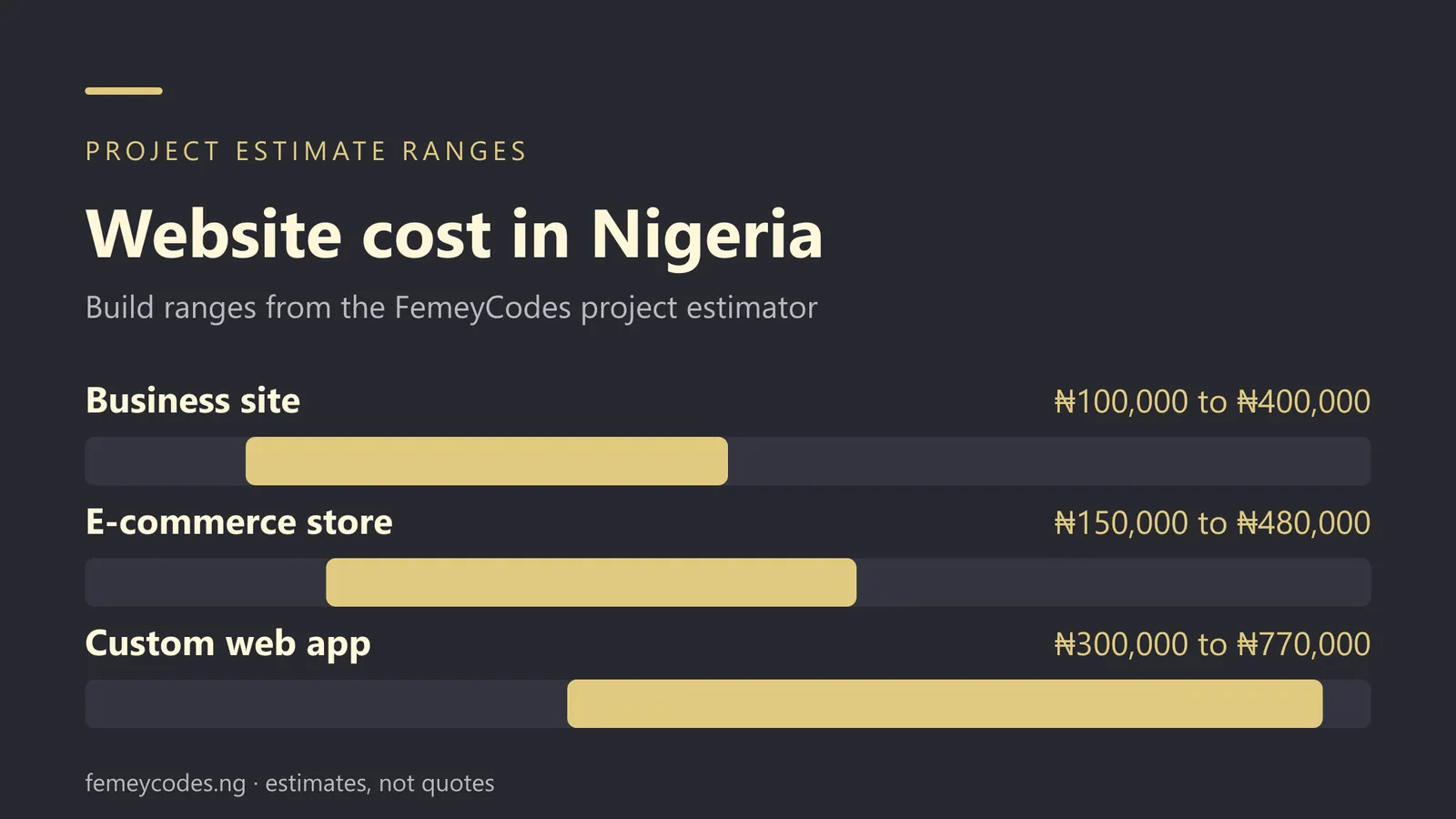
A business website in Nigeria costs between ₦100,000 and ₦400,000, an online store runs ₦150,000 to ₦480,000, and a custom web app starts at ₦300,000. Those are build estimates from our own project calculator, so you can check them yourself before you talk to anybody.
The final figure moves with design depth, page count, payment integration and how much control you need over content. What follows is the breakdown by website type, the bills that arrive after launch, and how to budget the spend without paying for features you will never use.
Website prices by type
These are build estimates only. Domain, hosting and maintenance are covered further down.
| Website type | Build estimate | Timeline | Usually included |
|---|---|---|---|
| Business site | ₦100,000 to ₦400,000 | 2 to 6 weeks | 5 to 8 pages, contact form, basic SEO setup |
| E-commerce store | ₦150,000 to ₦480,000 | 3 to 6 weeks | Product catalogue, cart, Paystack or Flutterwave checkout, order emails |
| Custom web app | ₦300,000 to ₦770,000 | 4 to 7 weeks | Login and roles, dashboards, integrations, admin panel |
The estimator builds these ranges from a base scope, plus the features you tick, multiplied by a complexity level: starter, standard or advanced. Pick starter with no extras and you land at the bottom. Tick every feature and move to advanced and you land at the top.
What pushes the price up, and what holds it down
Design depth is the biggest swing. A theme with your logo dropped in costs a fraction of a design built around your brand and your customers. Themes are fine for a first site. They get expensive the day you need the layout to do something the theme was never built for.
Page count matters less than people expect. Six well-planned pages usually beat twenty thin ones. What changes the price is a page with its own logic: a booking flow, a property search, a school portal that calculates fees term by term.
Payments are where Nigerian projects get specific. A Paystack or Flutterwave checkout covering card, bank transfer and USSD is straightforward work. Virtual account numbers, split settlements, refunds and reconciliation reports are not. Each one adds testing time, because money bugs are the ones you cannot ship and hope for the best.
Content is a choice you control. If your team supplies the words and the photos, the build stays lean. If the agency writes the copy, shoots your products and edits the images, that work shows up in the invoice. Neither is wrong, but you should know which one you are buying.
Admin features quietly add up. A shop owner who needs to change prices without calling a developer is a reasonable ask. Roles, permissions, audit trails and reports take time to build and time to test, and they are priced accordingly.
A cheap template site versus custom work
A cheap site is cheap because somebody already did the work once. You get a theme, a plugin stack and a weekend of setup. It looks decent, it loads, and for a while it sells.
Then the friction starts. The checkout does not match how your customers actually pay. The layout breaks on the small Android phones your audience uses. Adding a new product category means waiting on whoever built it. Custom work costs more up front because the structure is designed around your process instead of a vendor's assumptions.
The honest test: if the website is your main sales channel, pay for the custom build. If it is a brochure that lists your address, your services and your opening hours, a template will do that job for years. Read our guide to custom website development if you are still deciding which side you are on.
The costs that show up after launch
The build invoice is not the whole bill. Four yearly costs arrive whether you are ready or not:
- Domain: a .ng or .com.ng name renews yearly, typically ₦10,000 to ₦30,000 depending on the registrar and the extension you pick.
- Hosting: shared hosting for a small site usually lands between ₦6,000 and ₦40,000 a month, and most hosts discount it if you pay yearly.
- SSL: most modern hosts include the certificate free. If yours charges, budget up to about ₦20,000 a year. A padlock in the browser is not optional when you take card payments.
- Maintenance: updates, backups, plugin fixes and small changes. Light support runs from around ₦30,000 a month, while a busy store with regular changes needs more than that.
Prices in this list move, so check current rates with your registrar and host rather than trusting last year's figure. The point is to put these lines in the budget on day one instead of discovering them in month three.
How long does a website take?
A straightforward business site takes 2 to 6 weeks from kickoff to launch. That range comes from the estimator: two weeks for a basic build, up to six once you add user accounts, payments and file handling. E-commerce sits at 3 to 6 weeks and custom web apps at 4 to 7.
Timelines slip for reasons that rarely have to do with code. Waiting on copy, product photos, logo files and domain access is usually the longest part of a project. Get those ready before kickoff and you cut weeks off the calendar.
How to budget for a website in 2027
Start with the numbers, not a guess over WhatsApp. Pick your project type, set the scale to starter, standard or advanced, tick only the features you can name a use for, and read the range. That figure is your working budget, not your ceiling.
Then add 15 to 20 percent for the first year of running costs: domain renewal, hosting, SSL, maintenance and the small fixes that always arrive. If the total does not fit this quarter, split it. We take installment payments at FemeyCodes: a deposit to start design and development, a second payment when the build is ready for review, and the balance before launch.
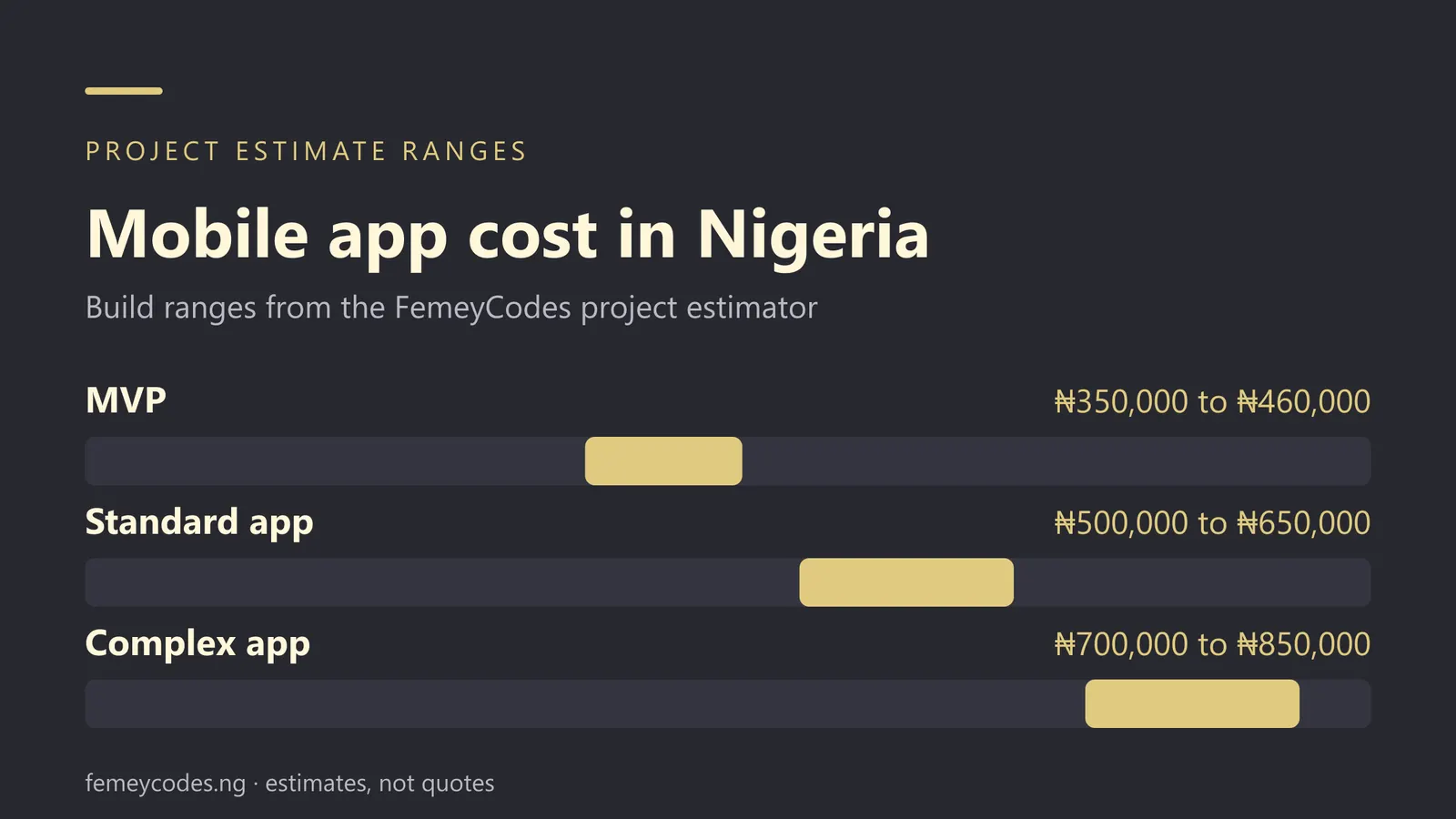
If you are weighing a store against an app, the numbers are different enough to be worth checking. Our guide to the cost of building a mobile app in Nigeria uses the same estimator, and our e-commerce website development team can tell you what a store actually needs in your category.
Questions people ask us about website costs
How much does a small business website cost in Nigeria?
Between ₦100,000 and ₦400,000 for the build, based on the ranges our project estimator produces. A five-page site with a contact form sits near the bottom of that range. Add user accounts, a payment flow or a custom design and you move up it.
How much does an e-commerce website cost in Nigeria?
Budget ₦150,000 to ₦480,000 for the build. Product catalogue, cart and a Paystack or Flutterwave checkout sit at the lower end. Delivery integrations, discount rules, multiple warehouses and detailed reporting push it higher.
How much does website maintenance cost in Nigeria?
Light support starts around ₦30,000 a month and covers updates, backups and small fixes. A busy store with regular changes needs a bigger retainer. Skip maintenance and you pay later in downtime, unpatched security holes and emergency repair work.
Can I pay for my website in installments?
Yes. FemeyCodes splits payment across milestones: a deposit to start design and development, a payment when the build is ready for review, and the balance before launch. Ask for the schedule when you request your estimate.
Get a number for your own project
Build your scope in the estimator and get a naira range and a timeline in about a minute, or send the scope to us on WhatsApp and we will talk it through with you.